


What is JMeter? JMeter, also referred to as ‘Apache JMeter’, is a purely java-based, open-source application used for load or performance testing of web applications and other network-based services. One of the key features of JMeter is its ability to simulate a large number of users accessing a web application concurrently and helps to identify the maximum operating capacity. This allows software testers to identify issues that may not be reproduced under normal conditions. JMeter provides a wide number of in-built listeners and visualization tools, that make it easy to analyse test results and identify areas for improvement. It can bring out detailed reports and graphs which provide insights about performance metrics like response time, throughput, processing rate, error rate etc. Architecture of JMeter:
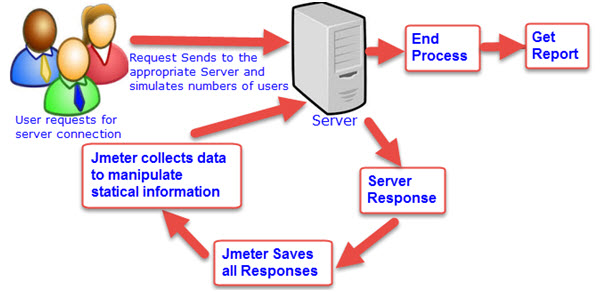
The architecture of JMeter is based on a client-server model, JMeter engine being the client and the application under test would be the server. The JMeter engine sends requests to the server and collects responses. The main components of JMeter architecture are as: Test Plan: This element defines the overall structure of the test. It contains few Thread Groups, representing a group of users that will be affected during the test. Sampler: A sampler generates a request to the server. JMeter supports various protocols such as FTP, SOAP, HTTP, HTTPS, and JDBC, each protocol having own set of samplers. Listener: A listener gathers and displays the response from the server. JMeter provides several inbuilt listeners like View Results Tree, Graph Results, Aggregate Report etc. Timers: Timers add a delay between requests, to produce a realistic load on the server. Controllers: They control the flow of requests and can be used to define conditions loops, branching in the test plan. Configuration Elements: These elements are used to set up different parameters like variables, cookies etc. Assertions: Assertions verify the response from the server. JMeter has inbuilt assertions like Duration Assertion, Response Assertion, Size Assertion. Advantages of JMeter: 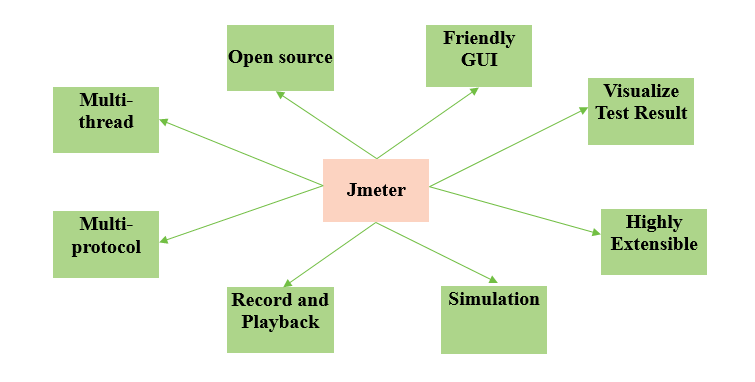 Open-source: JMeter is freely available for anyone to use, modify, and distribute. making it an affordable and easily accessible tool for load testing. Easy to use: JMeter offers a wide range of testing options and is very user friendly. Everything comes under one screen. Platform independent: JMeter is developed in Java, which itself is platform independent. Any operating system that supports Java supports JMeter including Linux, Windows, Mac, Ubuntu etc. Flexible and highly customizable: JMeter is customized according to the needs of various load testing scenarios. Supports multiple protocols: JMeter supports multiple range of protocols, including FTP, HTTP, HTTPS, JMS, JDBC and much more. This allows us to test a numerous applications and services. Distributed testing: JMeter supports distributed testing. Multiple JMeter instances are created and used to simulate many users. Thus, making it a perfect tool for testing all kinds of heavy applications that receive too much high-traffic of data. Real-time reporting: JMeter supports real-time analysis and test reporting which include process time, error rates, network delay, response times, and throughput which in turn help in developing better performances by application. Best Practices for JMeter Testing: Keep Test Scenarios Realistic: Mimic user behaviour (think time, traffic) to recreate real world scenarios. Parameterize Test Data: Parameterize your test data using variables (and CSV files) so you can test against multiple input values. Use Assertions: Use assertions to ensure properness in responses from servers. This aids in spotting unexpected behavior. Distributed Testing: With high-load testing, distribute the load with distributed testing where you can run multiple JMeter instances on multiple machines or machines using virtual machines. Monitor Resources: Watch for any bottleneck happening in your tests from the machine where JMeter is running. Regularly Review and Update Tests: As your app changes and new features are added, come back and adjust the test cases to account for new behavior and users’ actions. Conclusion: Apache JMeter is an excellent tool for implementing performance testing, load/stress testing, and other test cases for most applications or services with a remarkably high accuracy rate. Rich in features, flexible and open source, many developers and testers use it extensively. Adhering to industry-accepted best practices, and becoming an expert in JMeter’s features will allow us to be scalable (handle the high number of users) so the application can run well even when subject to massive load, leading to a greater user experience and increased customer.