


The Rise Of Fintech
In recent years, the financial services industry has seen a huge transformation. The biggest and most profound change has been Fintech, short for Financial Technology, where we are revolutionizing the way we invest, manage, and access our money. The Fintech industry uses new age technology like artificial intelligence, blockchain, data analytics (user- friendly services), and machine learning. Fintech can be dated back to the 1950s, to the introduction of credit cards. The advancement of internet and smartphones helped fintech finally gain recognition in the 21st century.
Impact on Traditional Finance
The revolution of Fintech began in 2006 when people were looking for alternatives to traditional finance, to avoid malpractice and something that was more transparent. The very first example of Fintech is P2P lending (peer-to-peer) where a platform was provided to exchange money without the inclusion of a traditional bank.
With the shift in the landscape, it has pushed the hand of traditional banks to keep up with the competition by investing in digital transformation.
Fintech has provided easy access to the unbanked or underbanked population and made it possible to conduct financial transactions from remote areas, thus reducing the financial exclusion gap.
Key Areas of Fintech
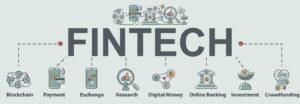
Digital Payments: Fintech is capturing the digital market by the way of payment apps like Apply pay / Google wallet, and P2P payment platforms like Venmo, PayPal, and TransferWise were sending and receiving money has never been easier, domestically, or internationally.
Digital Banking: Online-only banks known as neo banks are capturing the market by introducing low interest rates, low fees, and user-friendly interfaces. It provides users with seamless banking experience with budgeting tools and high yield savings account.
Robo-Advisors: The investment market has been taken over by robo-advisors where they use algorithms to manage portfolios, providing automated, low-cost, and diversified investment solutions.
Blockchain and Cryptocurrency: There is a new opening for decentralized financial transactions with the introduction of bitcoin and Ethereum. On the other hand, blockchain underpins these digital currencies and provides transparent, tamper-proof ledgers which could revolutionize the banking industry.
Crowdfunding: Individuals contributing funds to support projects and businesses has become easier with fintech platforms like Kickstarter and Indiegogo.
Benefits of Fintech
Convenience: Access to financial services anytime, anywhere, through mobile apps and online platforms.
Lower Costs: Reduced fees, competitive interest rates, and efficient operations often result in cost savings for users.
Innovation: Fintech encourages innovation, leading to the development of new financial products and services.
Security: Blockchain technology enhances security and transparency, making fraud and data breaches less likely.
Challenges in Fintech
With the evolution of the fintech industry, it is bound to face some major challenges such as, regulatory concerns, cybersecurity threats, and the potential for data breaches.
Regulation and Compliance: The regulatory landscape for Fintech is constantly evolving, and companies must navigate complex compliance requirements to keep the balance between innovation and law.
Cybersecurity: The investment to be made by the financial companies significantly increases with everything going digital since protection of sensitive financial information is paramount.
The Promising Future of Fintech
With the industry constantly evolving there are new emerging trends like decentralized finance (DeFi), central bank digital currencies (CBDCs), and the use of artificial intelligence (AI) gaining momentum.
Decentralized Finance (DeFi): The evolution of DeFi platforms has caused a disruption in the traditional banking services by offering decentralized lending, borrowing, and trading.
AI and Machine Learning: Fintech is leveraging AI and ML to enhance customer experiences, personalize financial services, improve risk assessment, and automate customer service.
Regulatory Evolution: Governments worldwide are working on regulatory sandboxes and proactive policies that are helping to create a balanced environment for Fintech development.
Environmental, Social, and Governance (ESG) Investing: Fintech is expected to play a significant role in the growth of ESG investing, enabling investors to align their portfolios with sustainability goals.

C O N C L U S I O N
In conclusion, Fintech has transformed the financial industry and will continue to do so with financial inclusion and its impact in areas such as blockchain, AI, cybersecurity, and regulatory evolution. It has the potential to make financial services accessible, efficient, and customized as per user requirements with the help of innovation and right regulatory support.
With the continuous evolution of fintech, it will play an important role in how we manage and access financial services in the coming years.
REFERENCES
- Borde, S. F., & Kumar, A. (2018). Fintech and Digital Financial Services: Regulatory and Policy Challenges. Journal of Public Affairs, 18(1), e1647.
- Mougayar, W. (2016). The Business Blockchain: Promise, Practice, and Application of the Next Internet Technology. Wiley.
- King, R., & Raja, V. (2020). Cryptocurrency: A New Investment Opportunity? Journal of Applied Corporate Finance.
- Schwab, K. (2017). The Fourth Industrial Revolution. Crown Business.
- Herring, R. J. (2017). Regulating financial innovation: A more transparent approach. The University of Chicago Law Review, 84(1), 181-236.
- Statista. (2021). Global fintech market size 2020-2025. Retrieved from https://www.statista.com/statistics/377403/worldwide-fintech-market-size/
- World Economic Forum. (2017). Beyond Fintech: A Pragmatic Assessment of Disruptive Potential in Financial Services. Retrieved from https://www.weforum.org/reports/beyond-fintech-a-pragmatic-assessment-of- disruptive-potential-in-financial-services