


Why AI Forgets: AI Memory, Context Windows & RAG Explained
Learn why AI models forget conversations, how AI memory works, and the role of context windows, RAG, and AI agents in building smarter systems.
A few weeks ago, I was using an AI assistant in a project for help. Initially, it was excellent. It made great recommendations, recognized what I was attempting to create, and even adjusted to my style. It was more like working with someone who could follow along than using a tool.
I didn’t have to repeat everything each time. I didn’t have to constantly explain context. I could focus on making progress.
Then, without warning, something changed.
A few messages later, the assistant started suggesting ideas I had already rejected. It brought up approaches we had already discussed and moved past. It ignored decisions that had already been made. The flow was gone. Instead of building forward, I was correcting it, reminding it, and pulling it back on track.
It felt like starting over; but only halfway. The worst part was not that it made mistakes. The worst part was that it had no sense that it had made them before.
That moment made something clear in a very simple way:
The problem wasn’t that the AI wasn’t smart.
The problem was that it couldn’t remember.
AI Feels Intelligent – But Only in the Present
Modern AI systems are really impressive. They can write clearly, create code, imitate tone and style, and clarify complex ideas. When you first interact with them, you might feel that they have a better understanding of your situation and are better able to meet your needs.
But that feeling is a bit misleading. An AI model does not naturally carry memory from one moment to the next. It doesn’t automatically have a sense of continuity in its design. Each response it generates is based on the information it has access at that exact time.
If it makes you think like it remembers something you said earlier, it’s usually because that information is still included in the present context it can see.
In other words, it’s not remembering… it’s re-reading.
Once that information goes out of view, it’s gone.
This is very different from how our human brains work. When we have a conversation, we build a mental image like thread. You remember what was said, what decisions were made, and what matters moving forward for next response accordingly.
AI doesn’t have that thread by default.
The Desk That Explains Everything
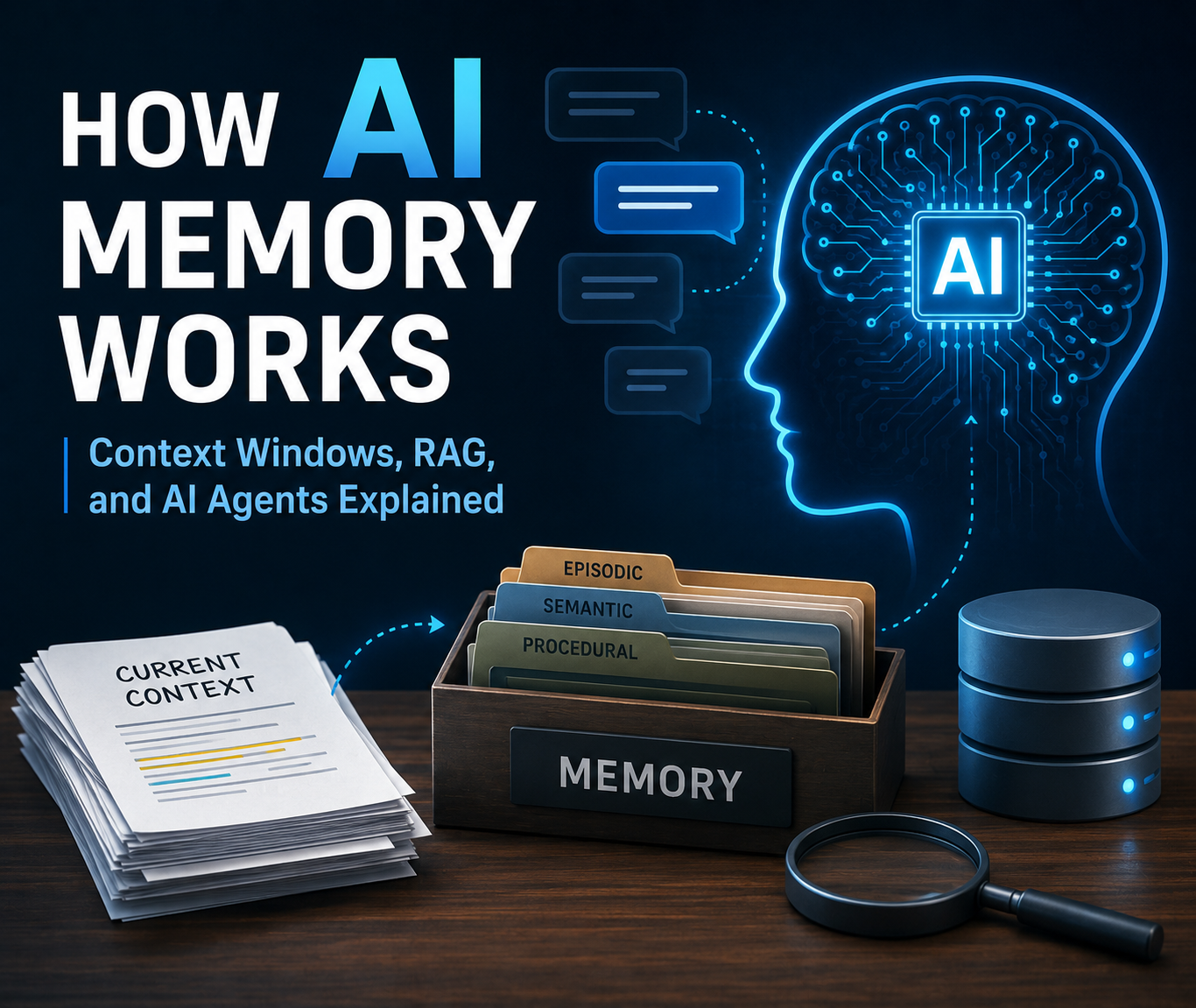
A simple way to understand this is to visualize your work desk and it has a lot of papers and folders on it.
Your desk is the space where you can actively think. The papers and folders on the desk are the pieces of information you can see and use at that time. Your brain is trying to process everything that is currently in front of you.
Now imagine two important limits.
First, your desk is small. You can only fit a small number of papers on it at once.
Second, every time you add a new paper, you have to remove an old one to make space. That is how an AI system operates.
The “desk” is what’s known as the ‘context window’. It defines how much information the model can handle at a single time. When the conversation grows longer or more complex, older details begin to fall off the desk.
At first, this might not matter. But as the interaction continues, those missing details start to add up.
Decisions are affected. Preferences can’t fit. Constraints won’t be remembered.
And when that happens, the AI doesn’t say, “I forgot something important.” It simply continues, filling gaps as best as it can. Sometimes it guesses. Sometimes it contradicts earlier ideas. Sometimes it confidently repeats things that no longer apply.
From the outside, it looks everything is correct. From the inside, it’s just working with an incomplete desk.
Why Not Just Make the Desk Bigger?
At this point, a natural question comes up: why not just increase the size of the desk?
Why not give the model a huge context window so it can hold everything?
Practically speaking, that approach runs into real limitations.
As the desk gets bigger, it takes longer to scan everything on it. That means slower responses. It also increases the cost of running the system, because more data has to be processed each time.
There is another issue. The model may become distracted when there is a large quantity of information. Large volumes of text might hide important details. More context can sometimes decrease accuracy rather than increase it. So even with larger context windows, the system still has to make tradeoffs. It cannot hold everything perfectly all the time.
The Difference Between a Model and an Agent
A basic AI model is primarily reactive. It takes an input, processes it, and generates an output. It does not plan ahead, track goals, or retain information beyond what is currently in its context window. Each response is generated as if it were an independent moment.
Building on top of it, an AI agent uses a model as a single component and adds structures around it, including planning, tool use, step-by-step execution, and sometimes even memory systems.
To put it another way, the agent is the system that tries to convert those responses into progress over time, while the model is the engine that generates responses.
But here’s the issue: An agent without memory is like a worker who forgets everything after each step.
Imagine asking someone to complete a task, but after every action, they lose all data about what they just did. They wouldn’t be able to improve. They wouldn’t be able to stay consistent. They wouldn’t even be able to avoid repeating mistakes.
That’s what happens when an AI agent lacks memory.
Memory is what connects actions into progress.
What Memory Actually Means in AI
When we talk about memory in AI, it’s important to be clear about what we mean.
We’re not talking about human memory, with emotions, experiences, and deep understanding. AI memory is more mechanical.
It is a system that can store information, retrieve it later, and use when needed.
There are several types of memory that people often refer to:
Working memory is what the model is actively using right now. It lives inside the context window and disappears when the interaction ends or moves on.
Long-term memory is stored outside the model. This could be in a database or another system that persists over time.
Episodic memory captures past interactions like what was said, what decisions were made, what happened during a session.
Semantic memory stores general knowledge, such as facts, rules, or domain-specific information.
Procedural memory captures how to do things. Steps, workflows, or patterns of action.
The key point is this: none of these exist naturally inside the model. They have to be designed and built around it.
The Workaround: Making AI “Remember”
Since models don’t have built-in memory, developers use techniques to recreate it.
One of the most common approaches is called retrieval-augmented generation, often shortened to RAG.
Idea is, instead of trying to keep everything inside the model, you store information externally. The system looks for relevant information when a new request is sent and adds them back into the prompt.
Typically, this involves changing data into numerical representations (known as embeddings), storing them in a database, and then using meaning to retrieve related items.
The information that was retrieved is then used by the model to produce a response.
So again, the model isn’t remembering in the human sense. It’s retrieving and reusing information at the right time.
This works very well for certain tasks, especially when dealing with documents, knowledge bases, or factual queries, but it also has its issues.
Why Memory Is Not Just About Storage
At first, it might seem like the solution is to store as much as possible.
If forgetting is the only problem, then keeping everything should help fix it.
But that approach quickly creates new issues.
Imagine your desk again, but this time you never remove anything. Every paper you’ve ever used is still there. Over time, the desk becomes cluttered. Finding the right paper becomes difficult. You spend more time searching than working.
The same thing happens in AI systems.
Too much stored information leads to noise. Irrelevant details start interfering with useful ones. The system may retrieve things that are technically related but not actually helpful.
This can slow down responses, increase costs, and reduce accuracy.
In some cases, it can even make the system appear more confused.
So memory is not about storing everything. It’s about selecting what matters.
When Memory Goes Wrong
Memory systems can fail in ways that are subtle but serious.
One issue is memory noise. The system keeps information that is no longer useful, and that information starts affecting future responses.
Another issue is incorrect memory. If the system stores something wrong, it may continue to rely on it. Over time, that mistake becomes reinforced.
There are also hidden errors. Based on an incorrect memory, the AI might confidently respond, and the user might be unaware that something is wrong.
Another issue is security. Sensitive data may be retrieved in the incorrect context if it is stored without the appropriate controls.
These issues are challenging because they continue to exist. Memory errors, in contrast to one-time mistakes, can affect future interactions.
The Real Challenge: Choosing What to Forget
Designing a good memory system is not about maximizing storage.
It’s about making decisions.
The system has to decide what to keep, what to compress, and what to remove.
Sometimes this involves summarizing long conversations into shorter, meaningful representations. Instead of keeping every detail, the system keeps key points.
Other times, it involves filtering. Only information that is relevant to future tasks is stored.
There is also pruning, where older or less useful data is removed entirely.
These decisions are not trivial. If you remove too much, you lose important context. If you keep too much, you introduce noise.
So, the goal is balance.
Good AI memory systems are not defined by how much they remember. They are defined by how well they forget.
RAG Is Helpful – But Not Enough
Retrieval-augmented systems are powerful, but they are often misunderstood.
They are excellent for searching and retrieving information. They work well for answering questions, referencing documents, and pulling in external knowledge.
But they are not a complete solution for memory.
They do not naturally track user preferences over time. They do not build a consistent understanding of goals. They do not evolve in a meaningful way unless additional systems are built on top.
In other words, they can recall information, but they don’t develop understanding.
True memory systems are more dynamic. They update, adapt, and refine what they store based on ongoing use.
How Agents Actually Use Memory
In practice, many AI systems follow a loop that looks like this:
Input → Retrieve → Think → Act → Store
First, the system receives a request.
Then it retrieves relevant memory from external storage.
Next, the information is processed and decided what to do.
It takes an action or generates a response.
Finally, it stores new information based on what just happened.
Over time, this loop creates the appearance of learning.
But what’s really happening is continuous updating. The system is constantly adjusting what it keeps and what it ignores.
It is not learning in the human sense. It is managing information.
The Biggest Misunderstanding
One of the most common assumptions is that more memory automatically leads to better AI. It sounds logical, but it’s wrong.
Too much memory can reduce clarity. It can introduce conflicts. It can slow everything down.
The real challenge is not capacity. It is judgment.
Knowing what to keep.
Knowing what to ignore.
Knowing what to forget.
These decisions shape how the system behaves more than raw storage ever could.
The Tradeoffs Behind the Scenes
Every memory system has to balance three key factors: accuracy, speed, and cost.
Improving accuracy often requires more data and more processing. That can slow things down and increase cost.
Improving speed may require simplifying or limiting what the system considers. This can reduce accuracy.
Reducing cost often means making compromises in both speed and depth.
There is no perfect solution. Every system is making tradeoffs based on what matters most for its use case.
Why This Matters More Than It Seems
At first glance, memory might seem like a technical detail.
But it has a direct impact on how AI feels to use.
A system without memory feels inconsistent. You have to repeat yourself. You have to correct it. You have to manage it.
A system with well-designed memory feels different. It feels smoother. It feels more aligned. It feels like it understands not only what you are saying, but what you are trying to do.
That difference changes the experience completely.
Looking Ahead
As AI continues to evolve, memory will play a larger role.
Future systems will likely become better at tracking preferences, remembering goals, and maintaining consistency over time.
They will not just respond, they will also adapt.
At that point, memory will no longer feel like a feature added on top. It will feel like a core part of how the system works.
Final Thought
As AI systems evolve, memory architecture will become one of the most important differentiators between reactive tools and truly intelligent agents. Understanding how AI remembers and forgets is essential for anyone building, using, or evaluating modern AI systems.
In general, we think that better AI will come from larger models capability, more data storage and processing, and more power efficient.
These elements are important, but they don’t provide the complete picture.
What truly makes the difference in an AI system is how it processes data over time rather than just what it can do in a single moment.
What matters the most is what it chooses to remember and, more importantly, what it chooses to forget, not how much it knows.
Frequently Asked Questions :
What Is AI Memory?
AI memory refers to the ability of an AI system to store, retrieve, and reuse information over time to maintain context and improve responses.
What Is a Context Window?
A context window is the amount of information an AI model can process at one time during a conversation or task.
Why does AI forget conversations?
AI forgets conversations because most large language models only process information within a limited context window and do not naturally retain long-term memory.
What is RAG in AI?
Retrieval-Augmented Generation (RAG) is a technique that retrieves relevant external information and adds it to an AI model’s prompt before generating a response.
Can AI agents remember users?
AI agents can remember users only if external memory systems are designed to store and retrieve user information over time.